Gate opener repair in Lancaster, CA
We connect Lancaster homeowners with a licensed gate contractor for automatic gate and opener repair: gates that stop halfway, reverse for no reason, hum without moving or go dead once the sun is down.
This is a referral service. The licensed contractor diagnoses the opener, quotes the repair and does the work. The quote is free.
- Common automatic gate repair
- $200 to $600
- Larger electric gate repair
- $500 to $4,000
- Replacement parts
- $25 to $1,000
- New opener, same gate
- $400 to $5,500
These are national averages from published cost guides. They are not a Lancaster quote. What failed matters more to the price than the brand does.
What the symptom usually means
How an opener fails tells you a lot. Before you call, find what yours is doing in the list below and pass it on to the contractor. That often shortens the visit and the bill.
Opener problems, part by part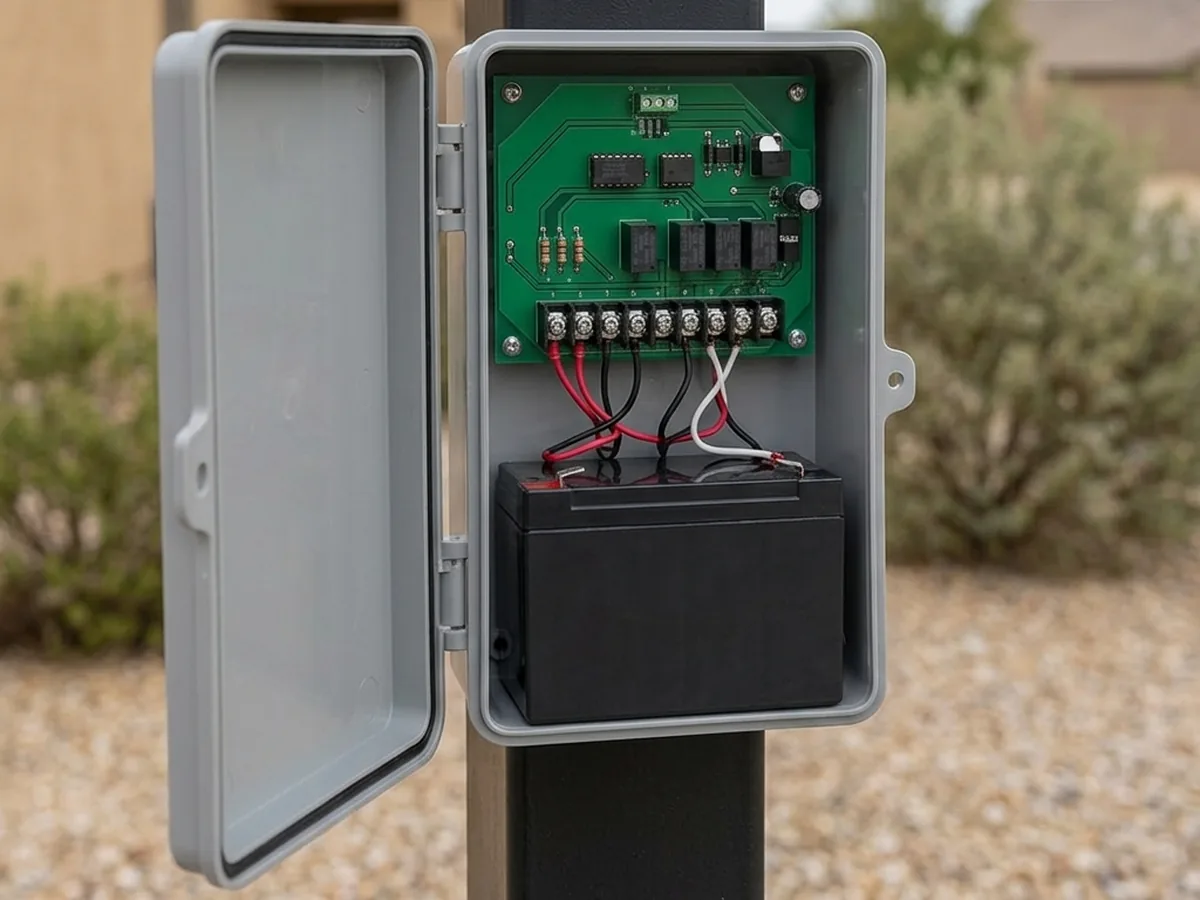 Illustration
- The gate does nothing at all
- No power reaching the board: a tripped breaker or outlet, a blown fuse at the control board, or a flat battery on a solar unit. Check the breaker and any battery light first.
- It opens, then reverses or stops partway
- A safety device thinks something is in the way. Dust on the photo eye lenses, eyes knocked out of line, sand on a slide track, or a hinge binding so the operator senses extra force.
- The motor hums but the gate does not move
- Often a failed capacitor, a stripped gear or an arm that has come loose from the leaf. This one needs the contractor.
- The keypad works but the remote does not
- A dead remote battery, or the remote has lost its pairing with the receiver. Try a fresh battery, then have it reprogrammed.
- Fine in the morning, dead by evening
- A solar system short on charge: a dusty panel, a panel in new shade, or a battery that no longer holds a full day.
- The gate drifts open or bangs in the wind
- A worn arm, loose mounting bolts or gearbox wear. The operator can no longer hold the leaf against a gust.
- It grinds, jerks or runs slowly
- Dry or worn rollers and hinges, grit in the track or chain, or a leaf that has sagged and now drags on the ground.
Four safe checks before you call
A lot of service calls come down to one of these. Never bypass a photo eye or an edge to make a gate run; those devices are the entrapment protection that UL 325, the gate operator safety standard, is written to cover.
- 01
Power
Check the breaker. On solar, check the battery light and wipe the panel.
- 02
Sensors
Wipe both photo eye lenses and make sure nothing blocks the beam.
- 03
Path
Sweep sand off a slide track and clear anything in the swing arc.
- 04
Release
Still stuck? Use the manual release, move the gate by hand, then call.
Why Lancaster is hard on gate openers
An opener that would run quietly for years in a sheltered yard has a rougher life on an open Antelope Valley lot. Wind, sand and a long run from the house account for a lot of the repair calls here.
Wind load
A swing operator has to hold its leaf against every gust. NOAA data for Fox Field shows 51 days with gusts of 40 mph or more in 2024, with a peak of 61 mph. All of that load goes through the arm, the gears and the mounting bolts. It's why worn arms and drifting gates are common here.
Sand and dust
The USDA soil survey maps most of Lancaster as loamy sand and sandy loam, and on a windy day some of it is in the air. It coats photo eye lenses and solar panels, fills slide tracks and chains, and grinds at rollers and hinges.
Distance from the house
Out past a long driveway, a gate often runs on solar, because trenching power out is costly. That makes the battery and the panel the parts to suspect first when a gate starts to quit late in the day or after a run of dusty weather.
Repair the opener or replace it
Most opener faults are in one part rather than the whole machine. The contractor should tell you which kind yours is, in writing, before any work starts.
All opener and repair pricesRepair when the operator is sound
Control boards, capacitors, sensors, batteries, arms and remotes can all be replaced on their own while parts are still made for the unit. National cost guides put common automatic gate repairs at $200 to $600 and single replacement parts anywhere from $25 to $1,000.
One national guide says most automatic driveway gates last 10 to 15 years with proper care. No guide gives a separate figure for the opener, so age alone is not a reason to replace one that still runs safely.
Replace when the motor or parts are gone
A failed motor or gearbox on an old unit, parts that are no longer made, or an operator that was undersized for the gate from the start. Adding a new opener to an existing gate runs $400 to $5,500 installed, per the same guides. A new operator should be listed to UL 325, and the installer should check the gate against ASTM F2200, the standard for automated vehicular gates.
If the gate crosses a fire apparatus access road, California Fire Code section 503.6 says the gate and its emergency operation must be maintained operational at all times, so a broken opener there should be fixed right away.
Who can repair a gate opener
Opener work is licensed in California. The CSLB D-28 classification covers contractors who install, modify or repair power activated gates and access control devices. New line voltage wiring falls under the C-10 electrical class.
How the referral works
Gates Lancaster CA does not repair openers itself. Tell us the make if you know it, what the gate is doing and when it started. We connect you with a licensed contractor who comes out, finds the fault and gives you a written price. You can check their license with the CSLB first.
When the whole gate needs replacing
Sometimes the opener is fine and the gate is the problem, or both are past saving. For a new gate from the posts up, see how we connect you with a gate company in Lancaster for a full installation, with the opener planned in from the start.
Keeping an opener running
Many repair calls could wait years with a little upkeep. National cost guides put routine gate maintenance at $100 to $300 a year, and most of the jobs below cost nothing but a few minutes.
After every windy spell
Wipe the photo eye lenses, sweep the track or the swing path, and look for anything the wind has jammed against the gate.
Every few months
Block the beam while the gate closes and make sure it reverses. Check that the arm bolts are tight and the hinges and rollers move without grinding.
Once a year
Have the contractor check the force settings, the battery and the wiring at the board, and replace the backup battery when it no longer holds a charge.
Gate opener questions
What are the common problems with electric gate openers?
Most faults come down to power, sensors or wear. A tripped breaker or a tired solar battery stops the gate cold. Dusty or misaligned photo eyes make it reverse. Worn arms, gears and rollers make it grind, drift or stall, and remotes lose their pairing. In Lancaster, blowing sand and wind speed up all of it.
What is the average lifespan of an automatic gate opener?
No national source gives a separate figure for the opener. One national cost guide says most automatic driveway gates last 10 to 15 years with proper care, and the backup battery goes sooner, every few years. Clean sensors and tracks, and a gate that hangs square, help an operator last.
How do I open my automatic gate when the power is out?
Use the manual release, usually a key or a lever at the operator, then move the gate by hand. Once power is back, re-engage the operator before you use the remote. If you cannot find the release or it will not turn, ask the contractor to show you on the repair visit.
How much does electric gate opener repair cost?
National cost guides put common automatic gate repairs, such as motor replacement, track adjustments and remote reprogramming, at $200 to $600. Bigger electric gate repairs run $500 to $4,000, and a new opener on the existing gate $400 to $5,500. No guide publishes a Lancaster figure.
Why does my automatic gate open and then close or reverse?
The operator thinks something is in the way. Check for dust on the photo eyes, a sensor knocked out of line, sand on the track or a hinge that binds. If those are clear, the force setting or the control board may need a technician. Never disconnect a sensor to stop the reversing.
Get your gate opener looked at
Tell us what the gate is doing and whether it runs on solar or house power. A licensed contractor follows up to book a visit and gives you a free written quote. You don't owe anything for it.