Gate opener problems, part by part
An automatic gate has four systems, and almost every fault lives in one of them. Go through them in this order. Either you'll fix it, or you'll know exactly what to tell the technician.
Power and batteries
Start here when the gate does nothing at all.
 Illustration
On a hardwired opener, check the breaker at the panel and any outlet with a reset button near the gate. If power is reaching the control box, most boards show a light; no light means the fault is upstream of the opener.
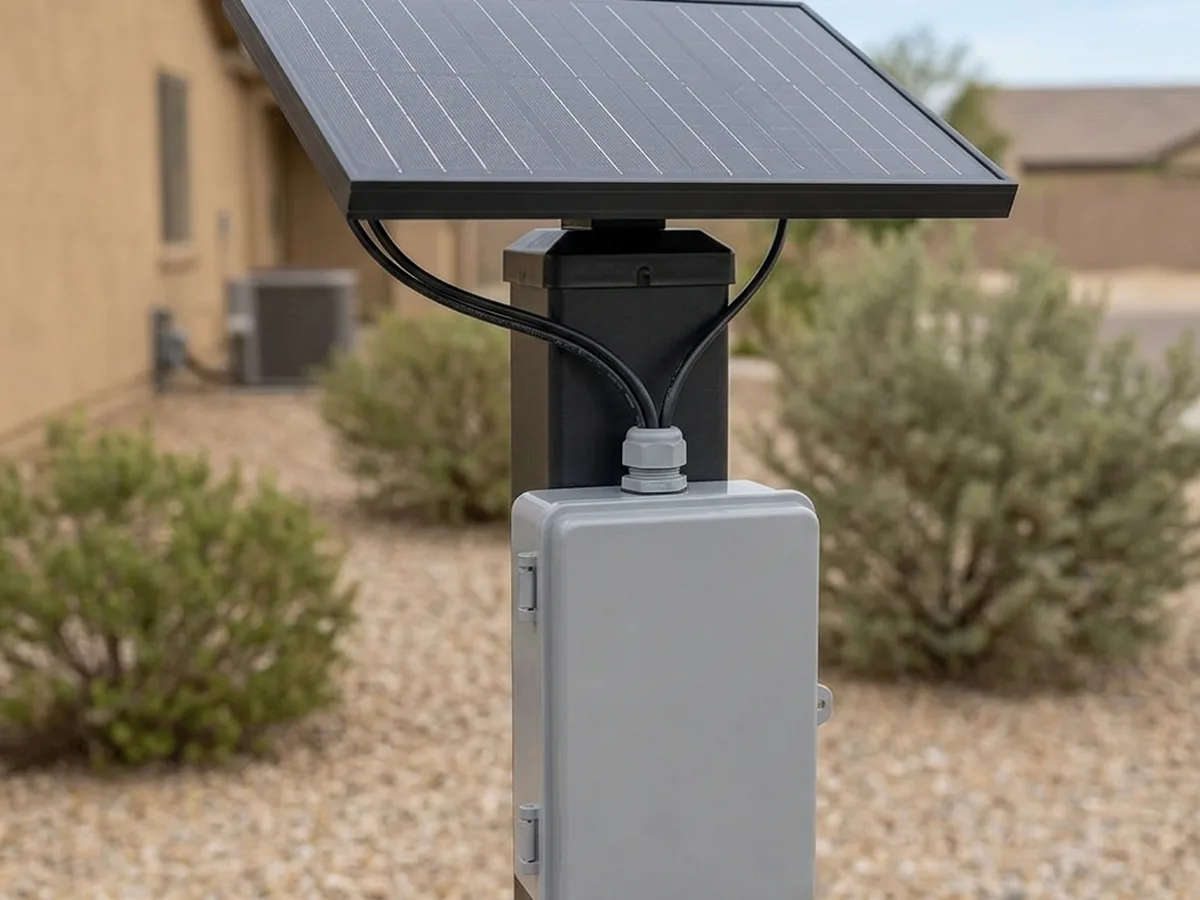
On a solar opener, the panel charges a battery and the battery runs the gate. A gate that works in the morning and quits by evening is running short of charge. Wipe the panel, check for new shade from a tree or a building, and count how many times a day the gate runs. One national cost guide says a gate opener battery needs replacing every few years, at about $20 to $85.
Safety sensors
A gate that reverses, stops partway or will not close is usually protecting itself.
Photo eyes send a beam across the opening, and contact edges on the leaf sense a bump. UL 325, the safety standard for gate operators, covers these as external entrapment protection devices. When one of them sees a problem, the gate stops or reverses. That's the system doing its job.
- Wipe both photo eye lenses. Dust from a windy day is enough to break the beam.
- Check that the two eyes still face each other. A bumped post knocks them out of line.
- Look for anything in the beam: a plant that has grown, a bin, a sagging wire.
- Check the edge strip on the gate for a tear or a loose wire.
Never disconnect or bridge a sensor to make the gate close. The fault is still there, and now nothing stops the gate from closing on a car or a child.
Remotes and keypads
If the gate runs from one control but not another, the opener is fine.
One remote fails
Replace its battery first. If it still fails, it has lost its pairing with the receiver and needs reprogramming from the control board.
Every remote fails
The receiver or its antenna is the likely fault. Check that the antenna wire is still attached and has not been cut or bent flat.
The keypad fails
Check its battery or wiring, then whether the code was changed. Sun and dust wear keypad buttons, and a worn keypad is a cheap part.
Arms, gears and the gate
Grinding, jerking, drifting and humming are mechanical, and mostly a technician's job.
Pull the manual release and push the gate yourself. If it drags, binds or sags, the opener is fine and the gate itself is at fault. Fix the hinges, rollers or track first; the guide to a sagging gate covers how. If the gate moves freely by hand but the operator hums, grinds or drifts, the fault is inside the operator, usually a capacitor, a gear or a loose arm.
Wind wears swing operators faster. NOAA data for Fox Field shows 51 days with gusts of 40 mph or more in 2024, and every gust loads the arm and gears holding the leaf. Automatic gate work in California is licensed under the CSLB D-28 class.
When the checks above do not find it, see gate opener repair for costs and what a repair visit covers, or how we connect you with a Lancaster gate company if the whole gate needs replacing.
Still not working?
Tell us what the gate does and whether it runs on solar or house power. A licensed contractor follows up to book a visit and a written quote.